Research
Research Vision
A unified research program for data-efficient, physics-constrained, and stable inverse modeling of complex physical systems.
Research Pillars
Data-Efficient Inverse Modeling for Ill-Posed Physical Systems
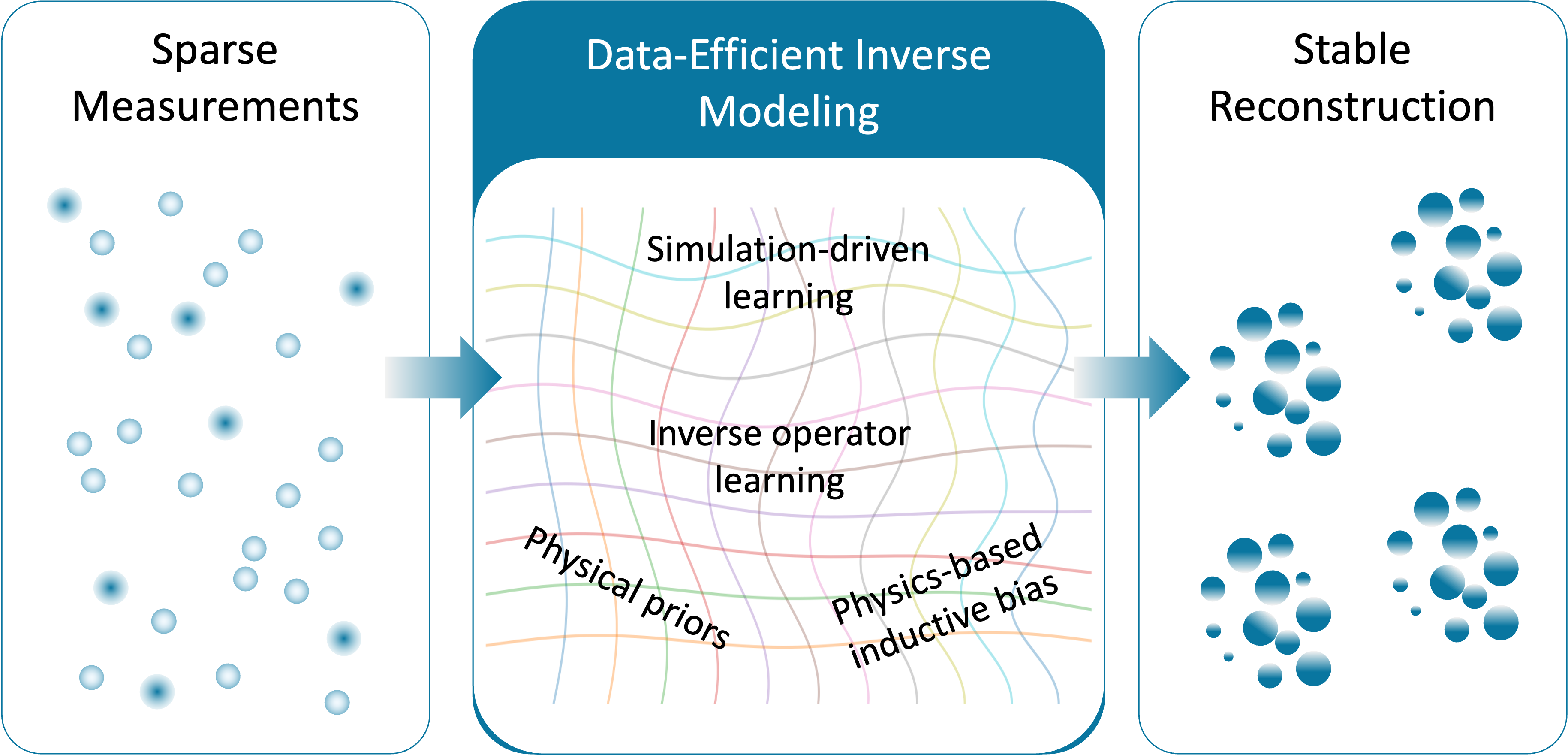
Learning stable inverse mappings from sparse, limited, and simulated data through physics-informed inductive biases.
Physics-Constrained Multimodal Inverse Problems
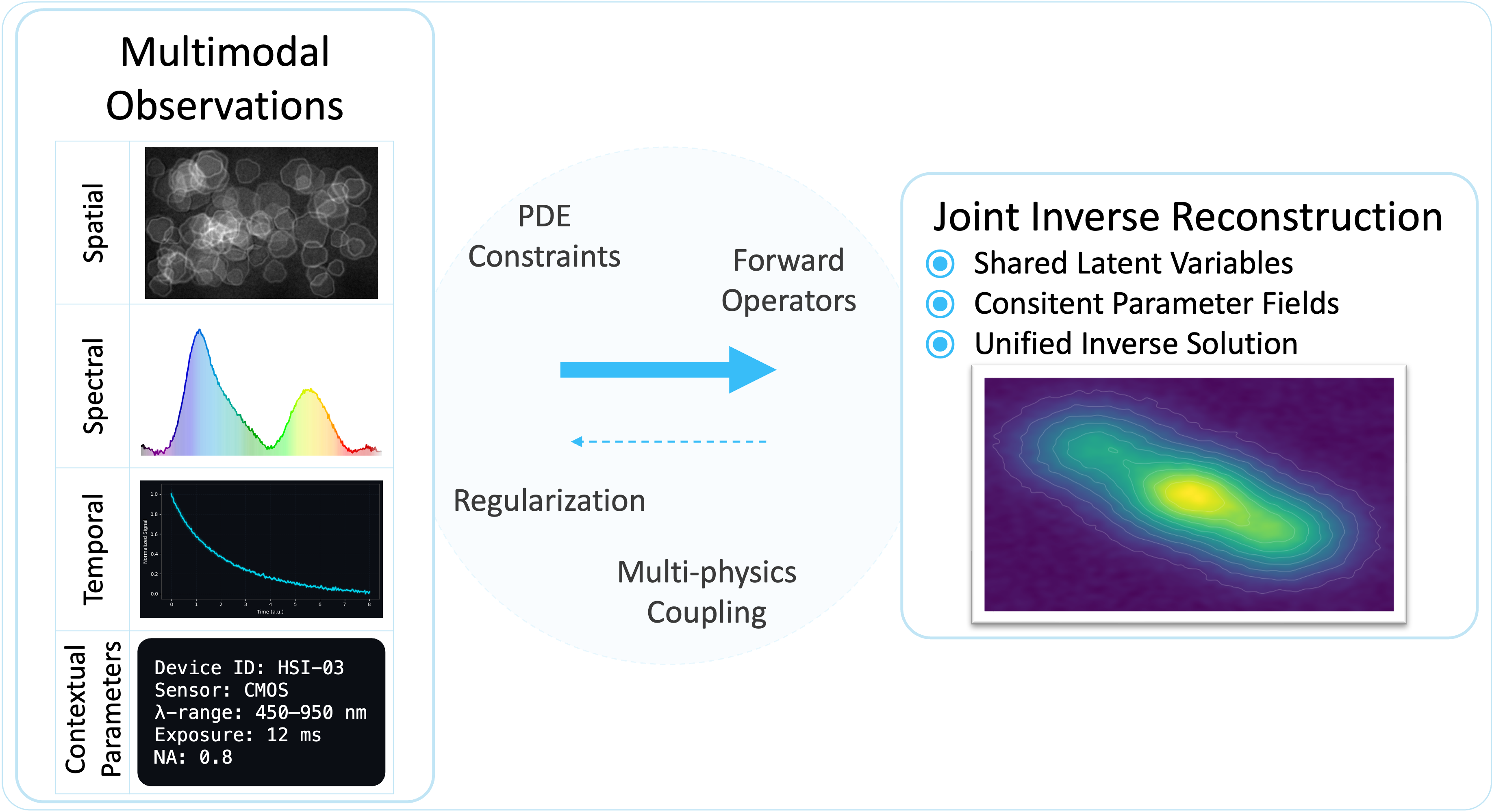
Reconstructing physical systems via joint inverse modeling constrained by PDEs, forward operators, and multi-physics structure.
Stability, Uncertainty, and Reliability of Inverse Models
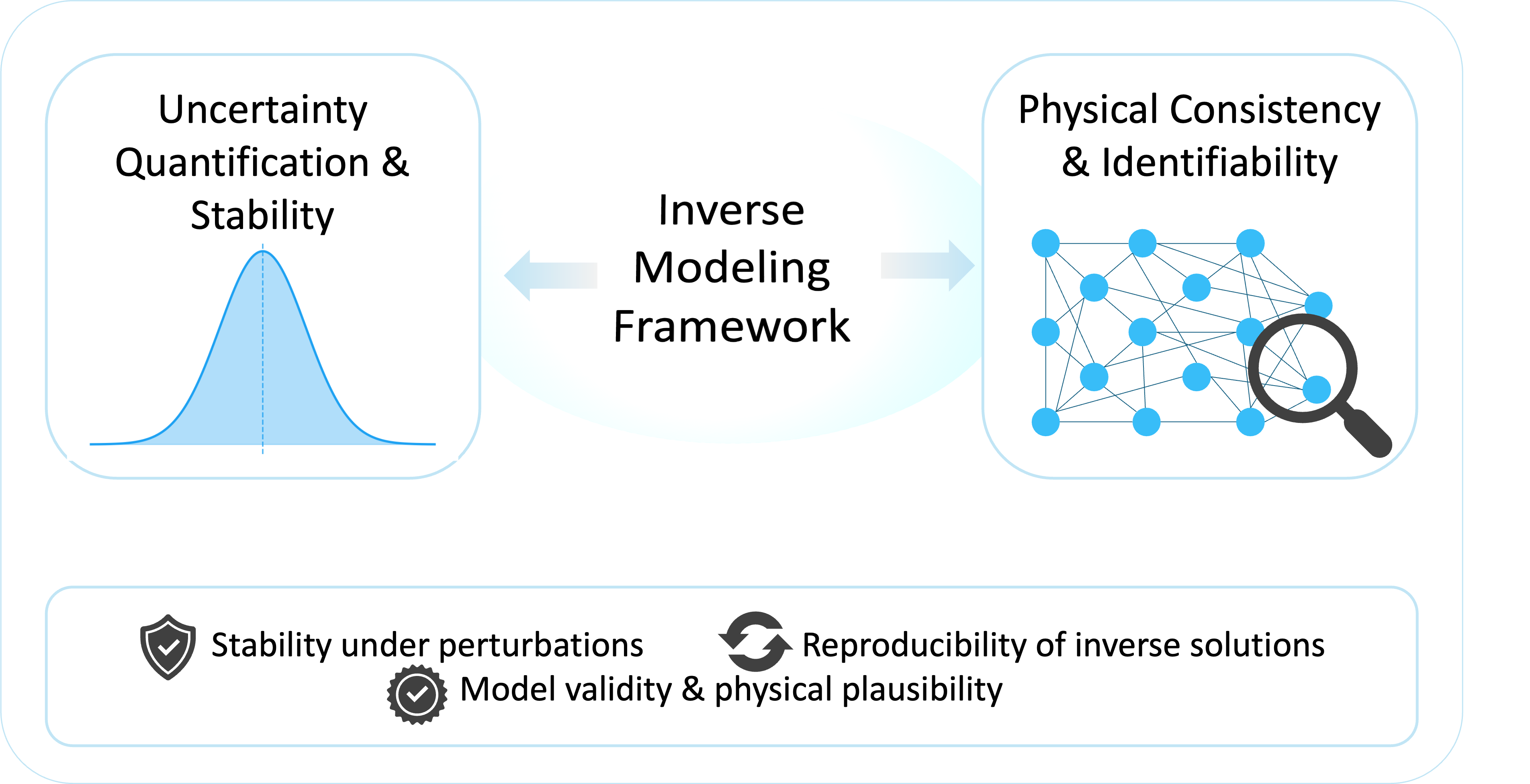
Establishing stable, identifiable, and physically consistent inverse models through uncertainty quantification and theoretical guarantees.
Focus Problems
My research is driven by fundamental scientific challenges arising in inverse problems, physical modeling, and scientific inference:
- Ill-posed inverse problems in imaging and sensing, where reconstruction is unstable, underdetermined, or non-identifiable due to sparse, noisy, or incomplete measurements.
- Reconstruction under data scarcity, including rare modalities, limited acquisition regimes, and low-sample scientific settings.
- Multimodal inverse problems, where heterogeneous observations must be fused through physically consistent models rather than data-level integration.
- PDE-constrained inverse problems, involving coupled physical processes and multi-physics systems.
- Identifiability and stability of inverse models, including sensitivity to perturbations, model mismatch, and measurement noise.
- Reliability of scientific reconstructions, focusing on physical plausibility, reproducibility, and consistency with governing laws.
- Context-conditioned inference, where biological, instrumental, and environmental variables influence the forward model and inverse solution.
These problems arise naturally in biophotonics, imaging physics, spectroscopy, and scientific sensing systems, but are formulated at a general mathematical and physical level.
Methods
My methodological approach integrates theory, physics, and learning within a unified inverse-problem framework:
- Inverse problem theory: ill-posedness analysis, regularization theory, identifiability, and stability theory.
- PDE-constrained modeling: forward modeling, coupled PDE systems, and physics-based constraints.
- Simulation-driven learning: synthetic data generation, physics-based simulators, and model-informed supervision.
- Inverse operator learning: learning structured inverse mappings under physical constraints.
- Physics-informed machine learning: embedding physical laws, priors, and inductive biases into learning models.
- Compressed sensing and sparse reconstruction: structure-exploiting recovery from limited measurements.
- Uncertainty quantification: Bayesian inference, probabilistic modeling, and uncertainty propagation.
- Model-based multimodal fusion: joint reconstruction through shared latent physical representations.
- Stability diagnostics and robustness analysis: perturbation analysis, sensitivity studies, and reliability evaluation.
The focus is not on black-box prediction, but on physically grounded, interpretable, and reliable inverse modeling for scientific systems.